Accessible Bathroom Adaptations in Derby: What's Worth Doing and What It Costs
Most bathroom adaptation conversations happen later than they should. Someone's had a fall, or a parent's mobility has changed faster than expected, and suddenly a bathroom that's worked fine for twenty years becomes the hardest room in the house to use safely. The good news is that a lot of the changes that make the biggest difference aren't huge building projects. Some are genuinely small jobs that can be done in a day. Others need more planning, but none of it has to mean ripping the whole room out.
Level-Access Showers: Usually the Biggest Single Change
If you're starting from scratch, Bathroom Fitters Derby can walk through which adaptations make sense for the specific layout of your bathroom, since what works in a large family bathroom doesn't always translate to a smaller en suite.
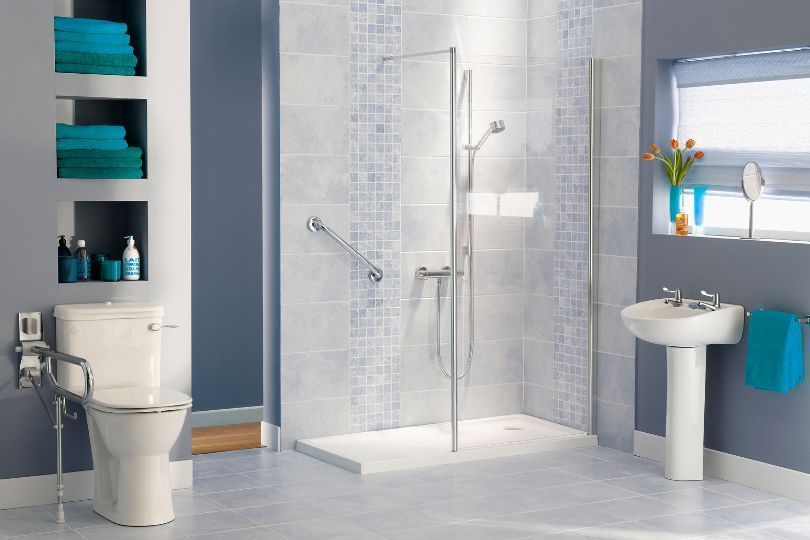
A level-access (or "wet room style") shower removes the step or tray lip that's one of the most common trip hazards in a bathroom. Instead of stepping over a raised edge, the floor slopes gently to a drain, meaning someone using a wheelchair, walking frame, or shower seat can move in and out without needing to step up or down at all. This is one of the most requested adaptations we see, and for good reason: it directly addresses the single biggest fall risk in most bathrooms.
We've covered walk-in showers versus baths from a general lifestyle perspective before, but for accessibility specifically, the level-access version goes further than a standard walk-in shower. It requires changes to the floor structure to create the fall towards the drain, which is more involved than fitting a low-threshold tray, but the end result is a genuinely flat, step-free floor.
Grab Rails Aren't Just for "Old People's Bathrooms"
There's a stigma around grab rails that doesn't really hold up once you think about it properly. A well-placed grab rail near the shower, by the toilet, or beside the bath isn't a medical fixture, it's a handhold, and most people use handholds without thinking twice in other contexts (stairs, buses, ladders). The difference in a bathroom is that wet floors and tiled surfaces make a slip more consequential, so having something solid to grab onto matters more, not less.
Modern grab rails come in finishes that match taps and towel rails rather than the clinical white plastic ones people picture. Positioning matters more than people expect, a rail in the wrong spot is barely better than no rail at all, so this is one adaptation where getting professional input on placement is worth it even though the rail itself is inexpensive.
Raised Toilets and Vanity Units
Standard toilet height is around 40cm, but raised versions (sometimes called "comfort height") sit a few centimetres higher, which makes a noticeable difference for anyone who finds it hard to stand up from a low seated position. Similarly, vanity units can be set at a height that suits someone who needs to lean on the sink edge while standing, or that allows wheelchair access underneath if needed.
These changes are easy to specify during any bathroom renovation and add very little to the overall cost, but they're almost never requested unless someone specifically asks, simply because most people don't think about toilet height until it becomes a problem.
Flooring: Grip Matters More Than Looks
Tile choice in an adapted bathroom needs to prioritise slip resistance over appearance, though the two aren't mutually exclusive these days. Textured porcelain tiles and certain vinyl flooring options now come in finishes that look like polished stone or wood but have a textured surface that grips far better when wet. Anti-slip ratings (often shown as an "R" rating, R9 to R13) give a rough guide, with higher numbers indicating better grip, though in practice, a quick barefoot test on a sample tile tells you more than the rating alone.
What This Typically Costs
A full accessibility-focused bathroom renovation in Derby, including a level-access shower, grab rails, raised toilet, and slip-resistant flooring, generally falls in a similar range to a standard full renovation, often £4,000-£8,000 depending on the size of the room and how much of the existing layout needs to change. Smaller adaptations on their own, fitting grab rails, swapping a toilet for a raised model, are far cheaper, often a few hundred pounds each, and can sometimes be done without touching the rest of the bathroom at all.
Some adaptations may also be eligible for funding support through Disabled Facilities Grants, depending on individual circumstances, which is worth looking into before committing to a full self-funded renovation.
FAQ
Q: What's the single most useful bathroom adaptation for someone with limited mobility? A: A level-access shower is usually the highest-impact change, since it removes the step or tray lip that's one of the most common trip and fall hazards in a bathroom.
Q: Do grab rails need to be installed in a specific way? A: Yes. Positioning matters significantly, a grab rail in the wrong spot offers far less support than one placed correctly. The rails themselves are inexpensive, but professional input on placement is worth it.
Q: How much more does an accessible bathroom renovation cost compared to a standard one? A: For a full renovation, the cost is often similar to a standard renovation, roughly £4,000-£8,000 depending on size and scope. Smaller individual adaptations, like grab rails or a raised toilet, cost considerably less.
Q: Is funding available for bathroom adaptations? A: Disabled Facilities Grants may be available depending on individual circumstances, and it's worth checking eligibility before committing to a fully self-funded renovation.
You might also like
Bathroom Fitting Derby